
Bounties near the bubble: how a PKO changes short-stack shoves and calls
By Carlos SilvaPublished
Three places from the money, it folds to you on the button with about 9 big blinds and J9s. In a regular hyper the solver shoves it 100% of the time. In a Speed Racer, with $109.38 on your head, it shoves it 0.1%.
I wanted to know what a progressive knockout really changes at the bubble, so I took the closest pairs of spots I could find in our library: Vanilla Tournament against Speed Racer, both Near Bubble, six-handed, three places from the money (30 left, 27 paid vs 29 left, 26 paid), blinds 0.5/1 with a 0.15bb ante.
I'm going to compare four decisions: a button shove, the big blind's call against it, a small blind against a big big blind, and a big blind who is the shorter stack. The short version: the bounty hardly moves how often the short stack shoves, it changes what it shoves with, and it moves the calling range a lot — but only for the player who covers.
Small blind against a big big blind
Now the blind battle. It folds to the small blind with 9.3bb in the Vanilla spot and 9.5bb in Speed Racer, and the big blind has 29.9bb and 33.9bb. The small blind's bounty in Speed Racer is $25.00, the starting head and the smallest at the table (1.0x in the viewer): knocking the small blind out pays only $12.50.
The small blind plays far more hands in Speed Racer: 56.9% against 43.0%. The shove itself grows only a little, 36.4% → 39.2%, with offsuit kings like K5o (0% → 100%) and K3o (0% → 74.6%) joining it. The rest is a 17.7% limp.
Read the pairs carefully. 99 goes from a 99.0% shove to a 0% shove, but it does not fold: the Speed Racer tree has no 2.5bb raise for the small blind, so its strong hands limp instead. AA, KK, QQ, JJ, TT, 99 and 88 all limp every time, where the Vanilla small blind raises AA 97.2% and KK 91.0% of the time.
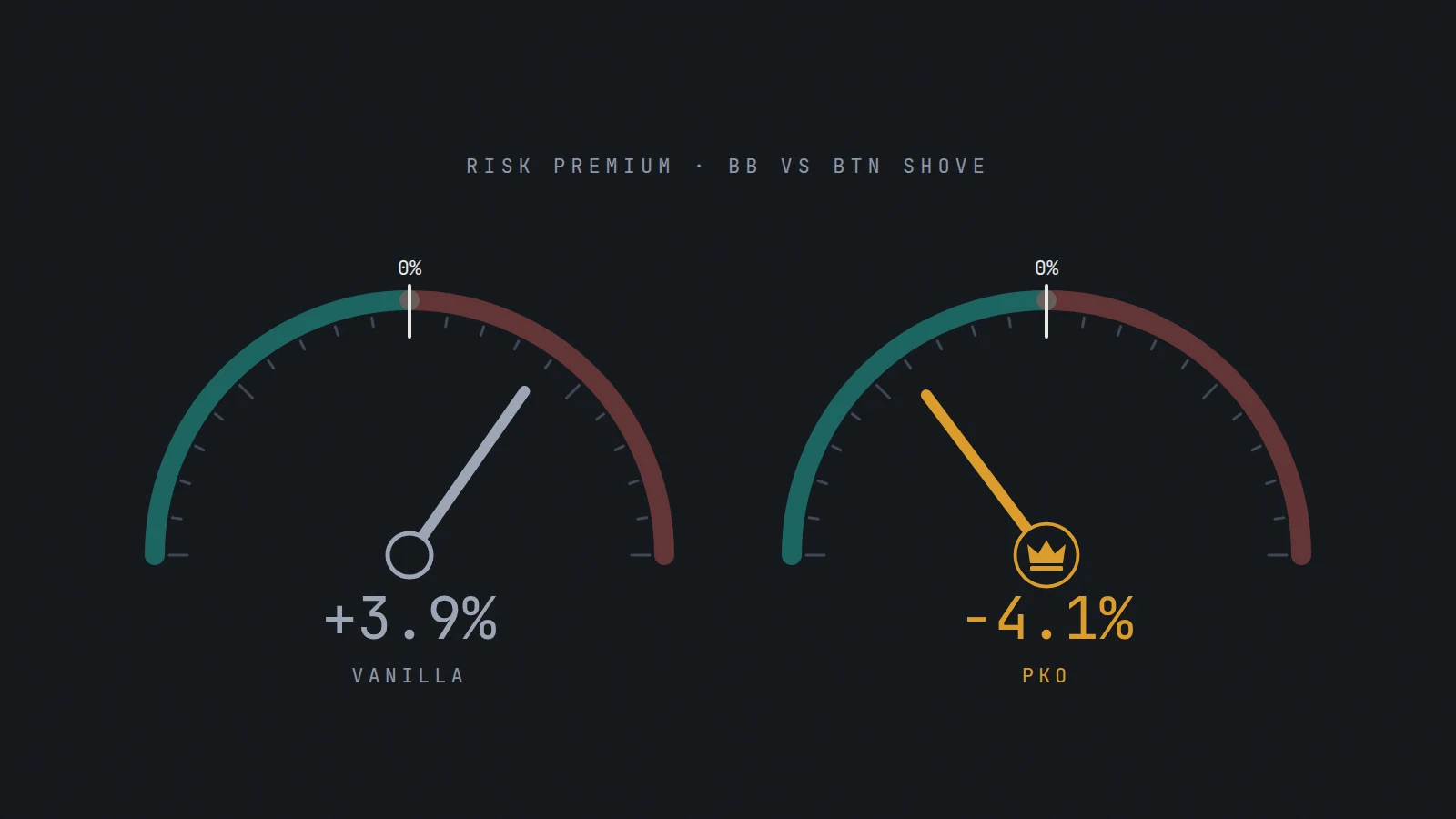
Then the big blind faces the shove. The Vanilla big blind calls 28.8% with a bubble factor of 1.11 (+2.6%); the Speed Racer big blind calls 34.6% at 0.98 (−0.4%). The extra calls are kings and broadways: K7o (0% → 100%), K8o (0% → 100%), JTo (0% → 100%), K3s (0% → 100%), Q8s (0% → 100%).
Why so much movement for a $12.50 bounty? Part of it is that bounty. The other part, as I read it, is the ladder: in a PKO half of the prize money is in the bounties, so the payout ladder that ICM taxes is smaller (the min-cash is $80.48 here, $110.00 in the Vanilla spot). You can see it in the small blind's own bubble factor against the big blind: 1.75 in the Vanilla spot, 1.42 in Speed Racer. Both players are under less pressure, so both play more hands.
Even the smallest bounty at the table moved the big blind's call from 28.8% to 34.6%.
When the big blind is the one covered
The last pair flips coverage. The LJ shoves 11.4bb in the Vanilla spot and 10bb in Speed Racer (8.2% and 9.0% of hands), and the big blind has only 8.3bb and 8.4bb. If the big blind wins, the LJ is still in the tournament, so there is no bounty for the big blind to collect.
The two calling ranges are the same hand for hand: 77+, AJo+ and AJs+, with one exception, ATs (0% → 99.9%). That is 7.2% against 7.5%. The bubble factors stay well above 1 in both: 1.54 (+10.6%) and 1.41 (+8.6%).
This is the other half of the bounty rule: only the player who covers can win a bounty. A covered big blind is playing for their tournament life, and the LJ is the one with a bounty to gain: $34.37 in cash for winning the pot. Nothing in that pushes the big blind wider.
No coverage, no discount: the covered big blind calls 7.2% in Vanilla and 7.5% in Speed Racer.
The same pattern across the library
Four pairs could be luck, so I ran the same walk over every six-handed Near Bubble spot of the two formats that is exactly three places from the money with 30 or fewer players left: a player with 8–12bb shoves first in and it folds to the big blind.
| Format | Big blind | Spots (decisions) | Average call | Average bubble factor |
|---|---|---|---|---|
| Vanilla Tournament | covers the shover | 25 (32) | 15.4% | 1.25 |
| Speed Racer | covers the shover | 7 (9) | 22.0% | 1.00 |
| Vanilla Tournament | is covered | 8 (9) | 38.7% | 1.42 |
| Speed Racer | is covered | 7 (10) | 34.5% | 1.39 |
When the big blind covers, the average bubble factor falls from 1.25 to 1.00 and the average call rises from 15.4% to 22.0%. When the big blind is covered, the bubble factor barely moves (1.42 and 1.39) and the call does not get wider. The Speed Racer side has only 9 and 10 decisions, so treat it as a direction, not a rule.
Near the bubble, a PKO changes who calls more than who shoves. The short stack's shove stays about the same size, loses its connectors and keeps its aces. The player who covers calls wider, by a lot when the bounty is big and still visibly when it is the smallest one at the table. The player who is covered plays almost exactly as in a Vanilla Tournament.
So the first question in a PKO bubble spot is not "how big is the bounty" but "who covers whom". Open the spots below and click through the same decisions; the bubble factor panel in the viewer shows the coverage effect in one number.